Chapel of the Holy Family, Silver Cliff, Wi
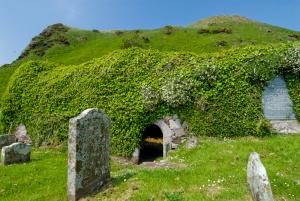
St Columba's Chapel
Amassed together on the rocky coast of Kintyre, south west of Southend, are 4 historic sites, 3 of which are linked to St Columba. Within like shooting fish in a barrel walking distance of each other are Keil Caves, used since prehistoric times, a holy well said to have been established past St Columba, a medieval chapel, and a fascinating footprint carved into a rock, said to be the saint's.
St Columba'due south Chapel
The name Keil comes from the Gaelic 'Kilcolmkill', meaning Columba's jail cell, or chapel. Within the grounds of Keil cemetery, overlooking the shore at the souther tip of Kintyre, is an ivy-shrouded chapel said to have been founded by St Columba. Unfortunately for the story, the chapel is likely to date from the 13th century, merely it has been congenital on a site closely linked to existent events associated with Columba.
In AD 563 Columba and 12 followers were exiled from Antrim in Ireland. They landed here in Kintyre on the first leg of their journeying that would see them spread Christianity throughout western Scotland and beyond. But did they country at Keil or further eastward at Dunaverty, where a fortress congenital by the Dalriada stood?
Only w of the chapel site is an ancient footprint carved into a rock, said to be the print of Columba's foot, and nearby is a holy well said to have been established by the saint. It seems just as likely that the footstep was carved as role of a traditional ceremony that formed part of Dalriada custom, but more on that in a moment.
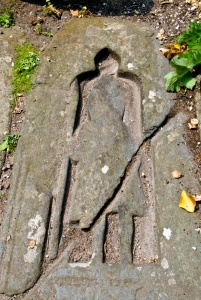
Medieval grave slab
inside the chapel
Did Columba build a chapel at Keil? Information technology seems unlikely, for Keil was simply a landing place, the commencement role of his journeying into exile. It seems much more plausible that the chapel was erected centuries subsequently on a site traditionally associated with stories of Columba, where there was already a holy well and formalism footprint linked to the saint.
The first tape of a chapel here comes from the early 14th century, when information technology was granted to Whithorn Priory, and we know that it served as many years as the parish church of Kilcolmkill. It ewas abased in the mid 18th century and is at present roofless.
Carved fragments of moulding suggests that there was a chapel here in the late 12th or early on 13th century, and rock from that first building was used to construct the present building later in the 13th century.
The chapel is completely covered in ivy, which looks absurdly romantic only does go far rather difficult to brand out the actual shape of the building. When I visited, the ivy was and so thick that it almost completely obscured an open up doorway into the chapel interior, and I wandered around the chapel for some time before I spotted the doorway amid the foliage and realised I could get inside!
Inside the chapel are several very old grave slabs, including a medieval slab incised with the carving of a knight. Another slab is carved with the symbol of a sword, also suggesting a knight, or warrior.
Both grave slabs were probably carved at Saddell Abbey, which had a very agile schoolhouse of etching during the 14th and 15th centuries. At that place may be more than, similar gravestones, only many are obscured by ivy or also worn to exist recognisable.
Outside the chapel are afterwards gravestones, including that of Ranald MacDonald, one of the very few people to survive a massacre at Dunaverty Castle in 1647. Ranald was the son of Sir Alexander MacDonald, la Royalist and leader of the castle garrison when it was besieged past a force of Campbells.
The infant Ranald was smuggled out of Dunaverty by his nurse, wrapped in a Campbell tartan to avoid suspicion. The program worked, and Ranald survived, though virtually of the garrison were killed.
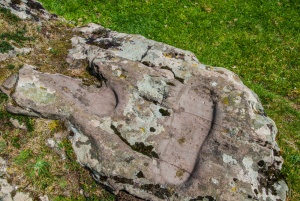
St Columba's Footprints
St Columba'due south Footprints
On a rocky outcrop between St Columba'due south Chapel and Keil Caves are a pair of footprints carved into the surface of a relatively flat rock. The footprints are reputed to be those of St Columba, who came to Kintyre around Advertisement 563 with a dozen followers, and is said to have landed here. Columba came from Antrim, just 12 miles away across the Irish Bounding main.
One of the footprints, the 1 closest to the ocean, is definitely of ancient origin, though it is impossible to say when information technology was carved. The other, further inland, is of recent vintage, carved in 1856 by a local bricklayer named Daniel McIlreavie. Information technology was McIlreavie who added the appointment '564' between the 2 footprints, though he got the engagement wrong by a year.
Past the sixth century, Kintyre formed part of the Kingdom of Dalriada, with its eye at Dunadd, in Kilmartin Glen. At Dunadd you tin can still meet a footprint carved into a stone. The footprint was said to have been used in ceremonies to inaugurate kings. Each landowner would bring soil from his state and identify it within the footprint. The new rex would place his foot upon the spoil, and the landowner would assert his allegiance.
Did the same thing happen at Keil? If and so, which came start? The tip of Kintyre was settled by members of the Scoti tribe from Ireland as early as the 2nd century. Could the Scoti, who gave their proper name to the nation of Scotland, have carved the first footprint as part of their system of allegiance and kingship?
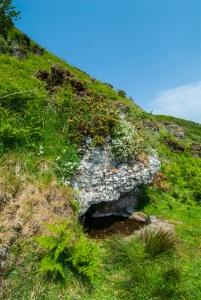
St Columba'southward Holy Well
It seems a more likely explanation than the proffer that St Columba made the footprint, simply nosotros know that Columba came hither to Keil, and so maybe ascribing the footprint to Columba merely tied together an already existing tradition with the spread of Christianity. Curiously, both carvings draw right feet, so when McIlreavie carved a new foot he did not brand a set, but a second right foot.
The Royal Commission on the Aboriginal and Historical Monuments of Scotland (RCAHMS) adds a different twist to the story. They say that the older footprint may be equally one-time as the stop of the 1st millennium BC, long earlier the coming of the Scoti and the Kingdom of Dalroiada. If then, what purpose did it serve?
The Holy Well
Just inland of the footprints is a well fix into the rocky cliff, on the line of the old coastal trail that runs simply inland of the churchyard boundary. The well is likewise ascribed to St Columba, and its waters are said to have healing properties. A basin has been carved into the rocky slope to collect water from a bound, and on the rock face that overhangs the bowl a crude Latin cantankerous has been carved.
The well is exterior the churchyard which seems odd if information technology really was linked to Columba. It is merely as likely that the link to St Columba was a fabrication of locals pandering to the tourists who began to flock to Keil in the 19th century. It certainly adds some other layer of interest to an already fascinating site!
Keil Caves
Excavations advise that Keil Caves were inhabited in early prehistoric times, for piles of shells have been constitute, and we know that i of the caves was used as a residence every bit recently as 1881. A census report from that year shows that ii families lived in the caves, with a total of six people.
1 of the caves is called Piper's Cave, and takes its proper name from a fable that a bagpipe thespian disappeared while on his way home past the caves ane dark night. The legend says that y'all can sometimes hear the lonely sound of ghostly pipes playing.
Legends autonomously, the caves are extremely basic openings in the rock face. It is truly hard to imagine anyone living here today, but they certainly are atmospheric, and provide a link betwixt the aboriginal past and the more relatively recent stories of St Columba.
Another interesting office of the story at Keil emerged (literally) in 1968, when fragmentary remains of a wheelhead cantankerous were discovered on the foreshore. The cross was just visible at low tide, and was plant almost straight reverse the chapel.
On the headland near St Columba'southward Footprints a socket was plant cut into a stone, which seems to fit the cantankerous base. So the cross appears to have stood on the cliffs, and at some point was broken up and thrown into the sea, presumably during the Reformation. The cross fragments can at present be seen at Campeltown Museum.
Visiting
The historic sites at Keil brand for a fascinating visit. The ruined chapel alone would be worth a visit, but the carved footprints and holy well add an extra bit of historical intrigue. The sites are well signposted, and located within a few minutes walk of each other. I also recommend a trip to Dunaverty Castle, simply a mile abroad.
Most photos are available for licensing, delight contact Britain Express epitome library.
Nearest Accommodation to St Columba'due south Chapel, Footprints, and Holy Well:
Nearby accommodation is calculated 'as the crow flies' from St Columba's Chapel, Holy Well, & Footprints. 'Nearest' may involve a long bulldoze up and downwards glens or, if you lot are almost the coast, may include a ferry ride! Please cheque the belongings map to make sure the location is right for yous.
Nearest Self Catering Cottages
More cocky catering well-nigh St Columba'south Chapel, Footprints, and Holy Well

Nearest Hotels
More than Hotels nearly St Columba's Chapel, Footprints, and Holy Well
Nearest Bed and Breakfasts
More than bed and breakfasts near St Columba'southward Chapel, Footprints, and Holy Well
Source: https://www.britainexpress.com/scotland/Strathclyde/churches/st-columbas-chapel.htm
0 Response to "Chapel of the Holy Family, Silver Cliff, Wi"
Postar um comentário