Christ With Scroll Symbolizes Old Testament in Byzantine Art

The Byzantine Empire nether the Emperor Justinian, c. 550 C.East.
The Byzantine Empire spanned more than a millennium and penetrated geographic regions far from the capital of Constantinople. Equally a result, Byzantine art includes works created from the fourth century to the fifteenth century and from such diverse regions equally Greece, the Italian peninsula, the eastern border of the Slavic world, the Middle E, and Due north Africa. Then what is Byzantine art and what do we hateful when we apply this term?
Events from the lives of Jesus Christ and his mother, the Virgin Mary, were amidst the most frequently depicted subjects in Byzantine art. Many of these events were recorded in the fourGospels in the Christian Bible, but others were also inspired past not-biblical texts, such equally the "Protoevangelion of James," which were nevertheless read by the Byzantines. The Byzantines commemorated these events as church feasts according to the liturgical calendar each yr (as does the Eastern Orthodox Church today, which is heir to Byzantium's religious tradition).
Depictions of these events appeared in a wide range of media, on unlike scales, and in public and private settings. It would be inaccurate to imply that these scenes were ever the aforementioned; they varied depending on the circumstances of their production equally well as the periods in which they were made. Acknowledging the risk of oversimplifying an creative tradition that endured for more than a millennium, this essay nevertheless seeks to introduce the stories and common features in Byzantine depictions of the lives of Christ and the Virgin.
Commonly depicted subjects in Byzantine art
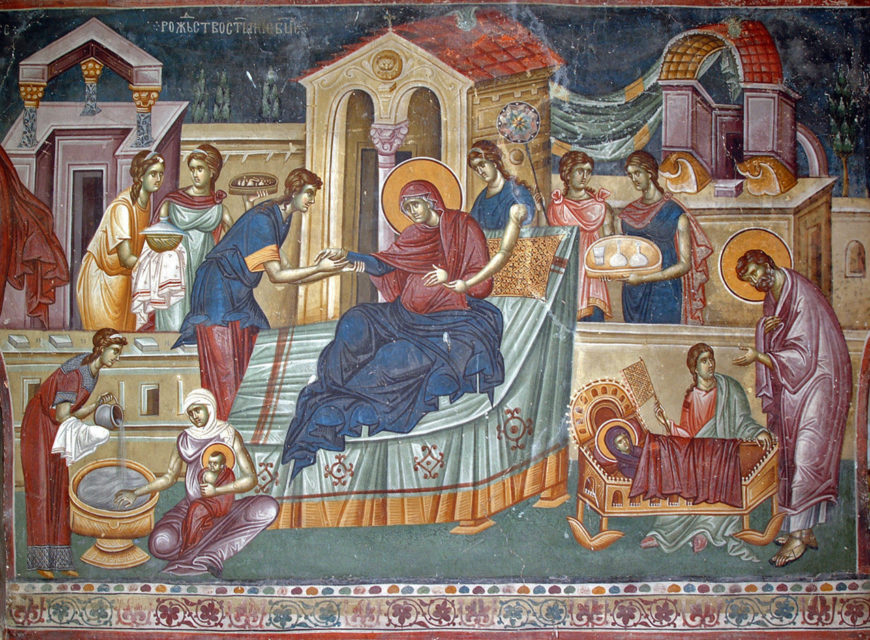
Nativity of the Virgin fresco, c. 1314, King's Church, Studenica Monastery, Serbia (photo: Blago, CC BY-NC-SA 3.0)
The Nativity of the Virgin
Drawn from non-biblical accounts such as the "Protoevangelion of James," the Nativity of the Virgin is commemorated as a Church feast on September eight. Anna, the Virgin'due south female parent, lies on a bed. Midwives bathe the newborn Mary. Other women bustle well-nigh, attending to Anna. Joachim, the Virgin's begetter, sometimes appears as well. At Studenica Monastery in Serbia, Joachim stands beside the Virgin every bit she lies in a cradle after her bath in the lower right. (view annotated image)
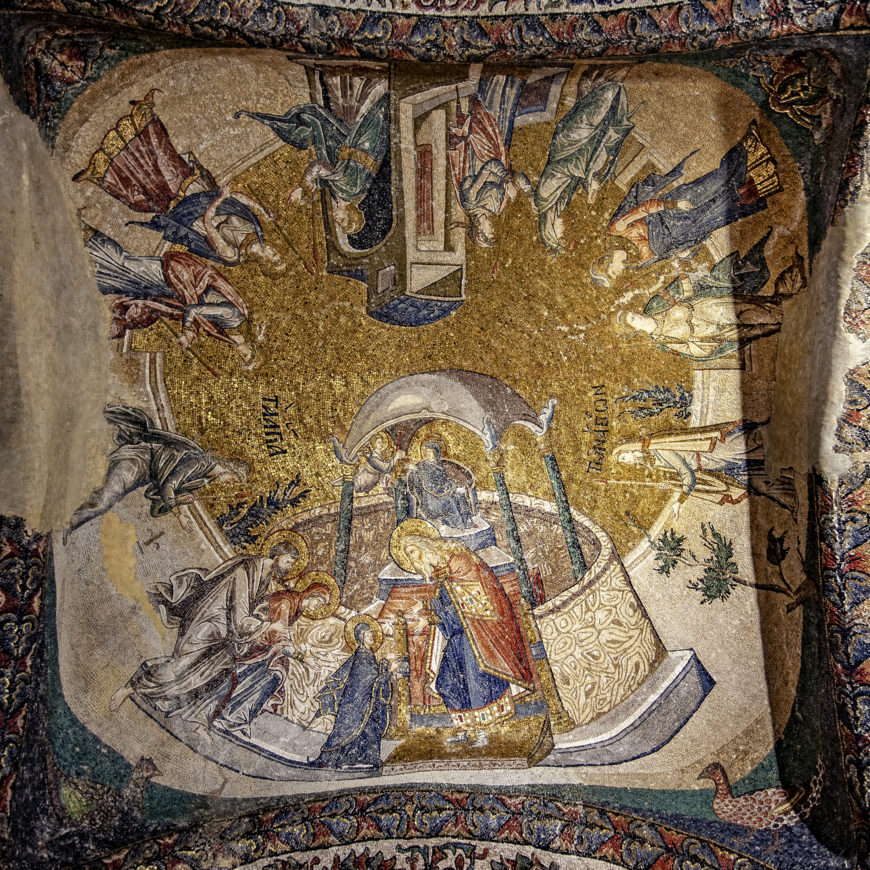
Presentation of the Virgin in the Temple, c. 1315–1321, Chora Monastery, Constantinople (Istanbul), mosaic (photo: byzantologist, CC BY-NC-SA 2.0)
The Presentation of the Virgin in the Temple
The Presentation of the Virgin in the Temple is based on non-biblical texts and is commemorated on November 21. The Virgin Mary is a kid. She processes with her parents, Joachim and Anna, forth with several candle-bearing maidens, toward the Jewish temple. Joachim and Anna offer the Virgin to God and the priest Zacharias receives her into the temple. As the narrative continues, Mary dwells within the temple, where an affections feeds her bread. The primeval examples of this image date to the tenth century. The hymnography for the feast emphasizes that the Virgin herself became a temple past allowing God to dwell in her when she conceived Christ. At the Chora Monastery, the procession to the temple takes a round grade to arrange the vault where information technology appears. (view annotated prototype)
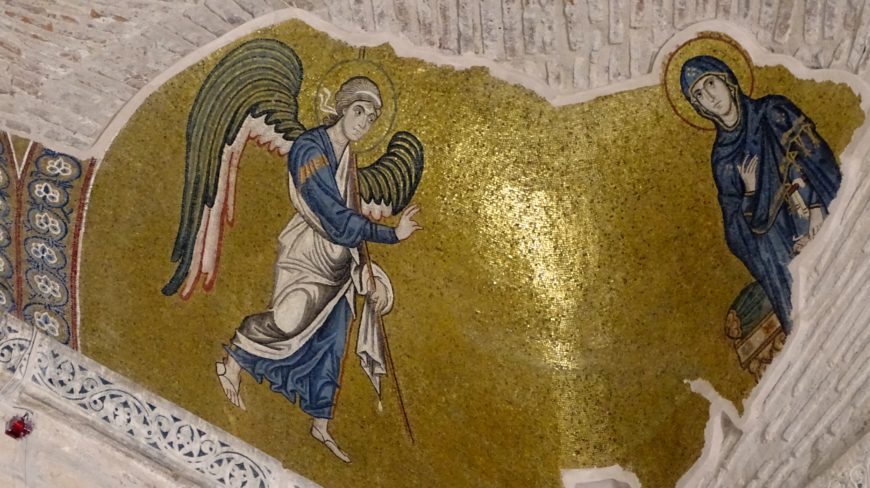
Annunciation mosaic, Daphni monastery, Chaidari, c. 1050–1150 (photo: Mark L. Darby, all rights reserved)
The Announcement
The Proclamation (Greek: Evangelismos) is recorded in Luke 1:26–38 and commemorated on March 25. Simple compositions, such as the mosaic establish at Daphni, bear witness the archangel Gabriel approaching the Virgin Mary to announce that the Holy Spirit will come upon her and that she volition excogitate the Son of God, Jesus. Other images show the Spirit descending every bit a dove on a ray of light. Artists sometimes include additional details from a non-biblical text known as the "Protoevangelion of James." The Virgin may agree scarlet thread to weave a veil for the temple or announced almost a well where she is drawing water when the angel approaches.
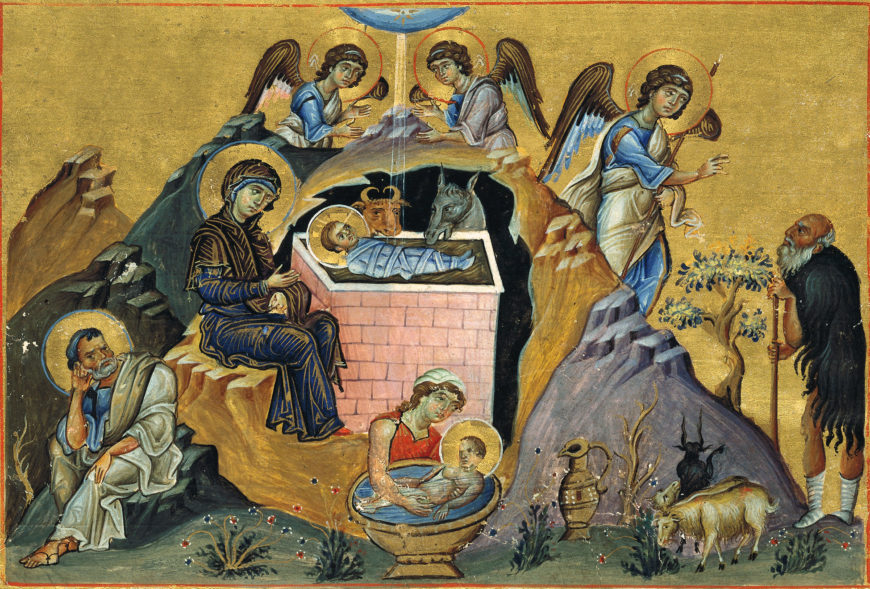
Nascency of Christ miniature in the Menologion of Basil Ii, c. 1000 (The Vatican Library, photo: Wikimedia Commons)
The Nascencyof Christ
The Nativity of Christ depicts the birth of Jesus. It is drawn primarily from Matthew i:xviii–2:12 and Luke ii:1–20and is commemorated on Dec 25. The newborn Christ appears in a manger (a feeding trough for animals) almost an ox and ass. The Virgin sits or reclines near Christ, but Joseph is usually relegated to the periphery (appearing in the lower left corner in the miniature from the Menologion of Basil II) to minimize his role in the Christ's birth (emphasizing Mary's virginity). The narrative continues with 1 or two midwives bathing Christ. Angels announce the expert news to shepherds. The star that guided the Magi from the due east shines downward on the Christ child. (view annotated paradigm)
The Meeting of the Lord in the Temple
The Meeting of the Lord in the Temple (Greek: Hypapantē) is described in Luke 2:22–38 and commemorated on Feb 2. Mary and Joseph enter the Jewish temple to sacrifice 2 birds and offering Jesus to the Lord, in accordance with the Jewish police force. They encounter the prophet Simeon (shown taking the Christ child in his arms in this prototype from The Metropolitan Museum of Art) and the prophetess Anna, who identify Christ as the Messiah. The temple is oftentimes visualized as a Christian church, indicated by a Christian altar and other church furniture. (view annotated image)
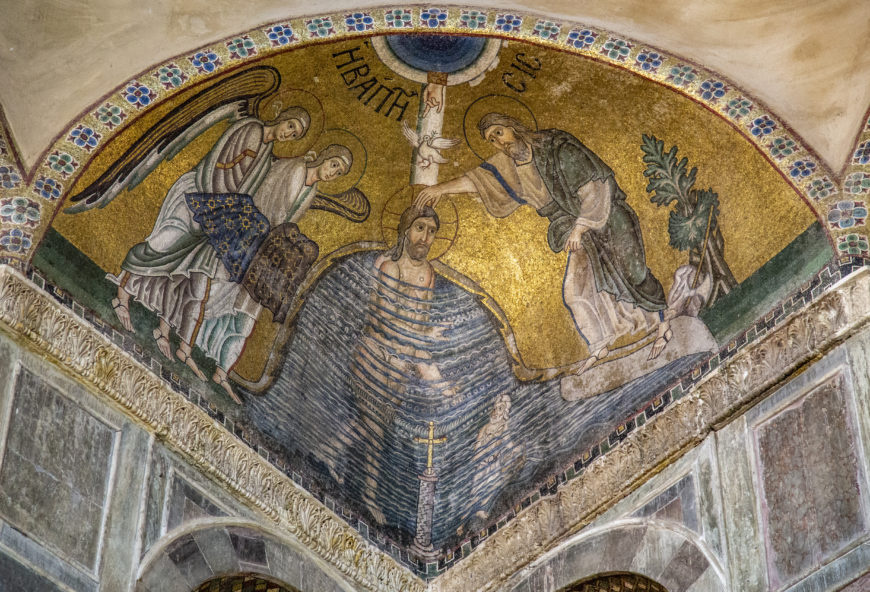
Baptism of Christ, 11th century, mosaic, Hosios Loukas Monastery, Boeotia (photo: byzantologist, CC BY-NC-SA 2.0)
The Baptism of Christ
The Baptism of Christ (sometimes called "Theophany" or "Epiphany") is recounted in Matthew 3:xiii–17, Marking 1:9–eleven, and Luke 3:21–22, and is commemorated past the Eastern Orthodox Church on January vi. John the Baptist, or
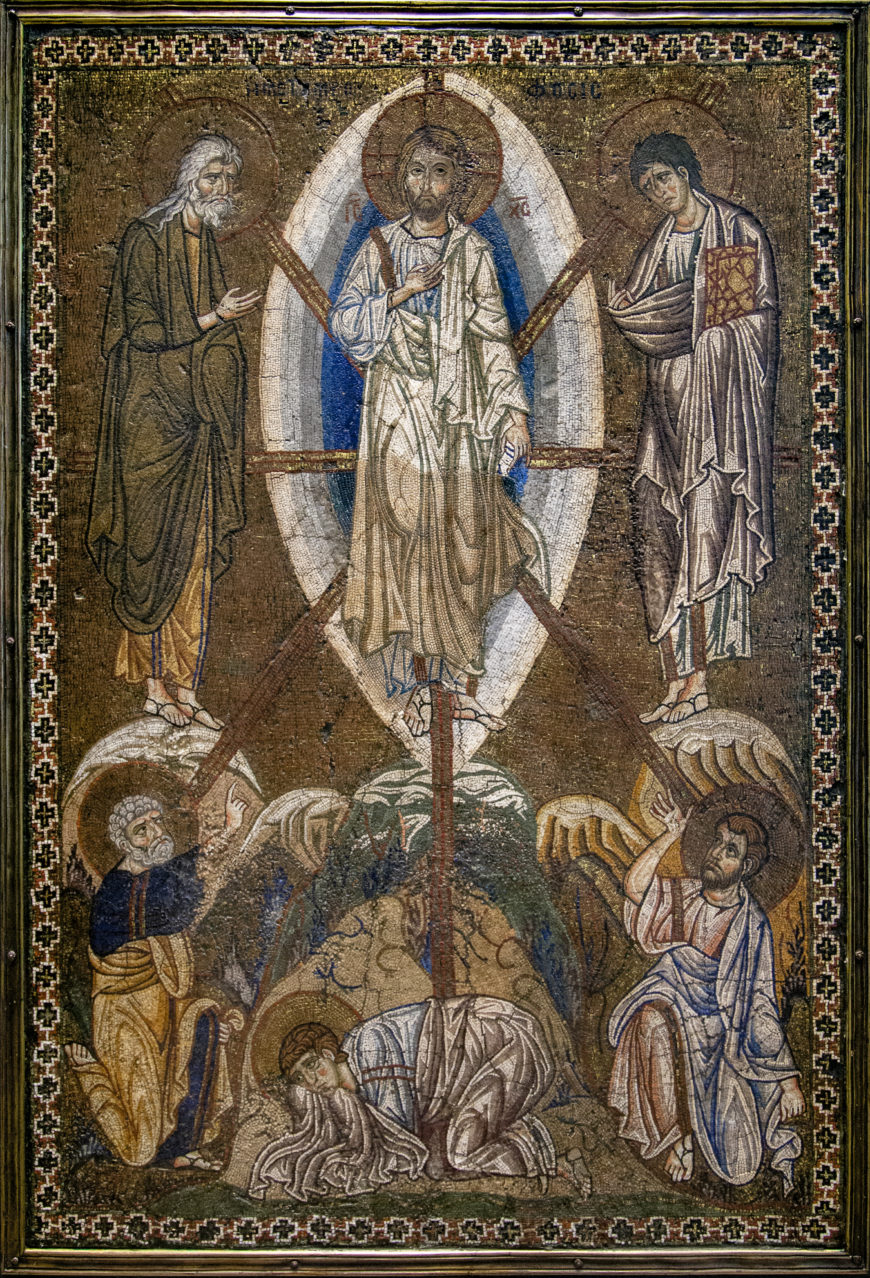
Icon of the Transfiguration, commencement of the 13th century, Constantinople, mosaic, 52 10 36 cm (Musée du Louvre, photo: byzantologist, CC By-NC-SA 2.0)
The Transfiguration
The Transfiguration is described in Matthew 17:ane–13, Marker 9:two–viii, and Luke 9:28–36 and is commemorated on August six. Jesus ascends a mountain (which tradition identifies every bit Mount Tabor) with Peter, James, and John (3 of his disciples) and is transformed so that he shines with divine light. This calorie-free often appears every bit rays and a mandorla (an almond- or circle-shaped halo of light), as seen in the mosaic icon at the Louvre. Moses and Elijah—two figures representing the law and the prophets from the Hebrew Bible—appear on either side of Christ. Early examples of this motif are found at the Monastery of Saint Catherine at Mountain Sinai and Sant'Apollinare in Classe. (view annotated prototype)
The Passion
The Passion ("suffering") refers to Christ'due south sacrificial death on the cantankerous and the catamenia leading up to it. It is commemorated annually during Holy Calendar week, whose dates vary from year to yr based on the lunar cycle.
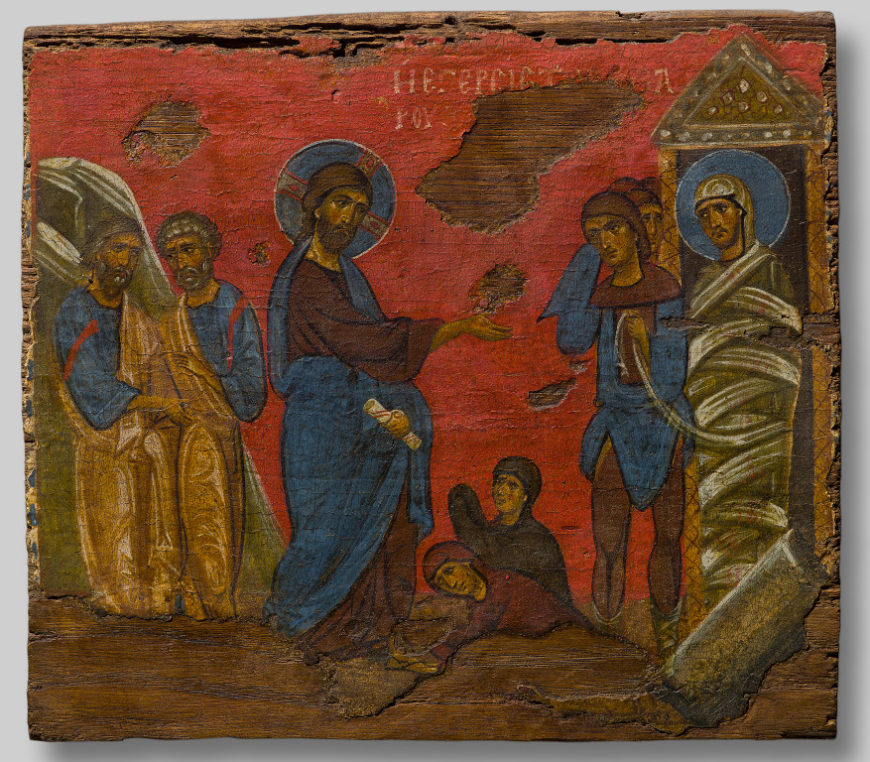
The Raising of Lazarus, fragment of a templon beam, 12th century, Mount Athos, tempera on wood, 21.5 ten 24 cm (Byzantine and Christian Museum, Athens)
The Raising of Lazarus
The Raising of Lazarus (a friend of Christ's) from the dead is recorded in John eleven:38–44. The Eastern Orthodox Church commemorates this miracle of Christ on the Saturday before Palm Sunday. Christ, trailed past the Apostles, calls along the shrouded Lazarus from the tomb, equally seen in the templon beam fragment in Athens. Mary and Martha, the sisters of Lazarus, kneel at Christ's feet. Additional figures open the tomb and gratis Lazarus from his grave apparel. One eyewitness ordinarily holds his nose because of the stink of Lazarus's decomposing body. (view annotated image)
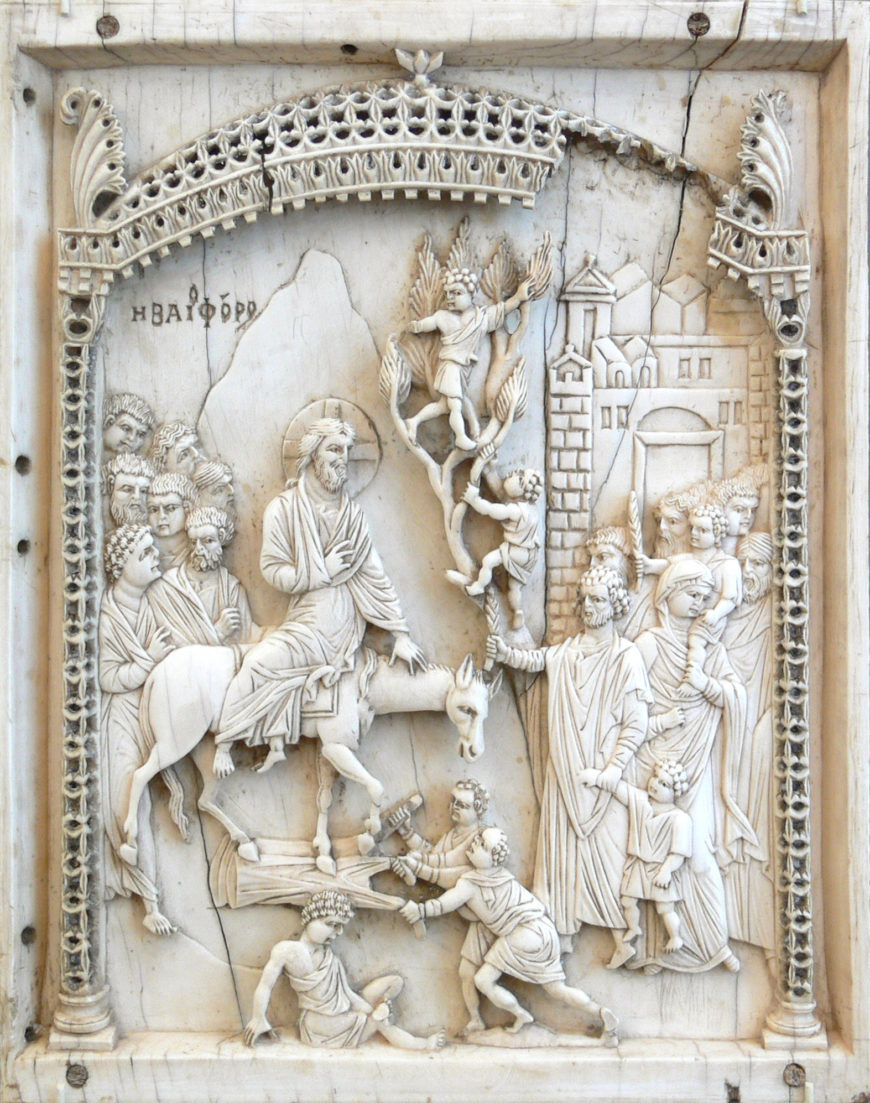
Center Panel of a Triptych Icon with the Entry into Jerusalem, 10th century, Constantinople, ivory, 18.4 10 14.7 cm (Staatliche Museen zu Berlin, photo: Andreas Praefcke, CC0)
The Entry into Jerusalem
The Entry into Jerusalem is recounted in Matthew 21:1–eleven, Mark 11:1–10, Luke nineteen:29–forty, and John 12:12–19 and is commemorated on Palm Sunday, the Sunday before Pascha (Easter). Jesus rides into the city of Jerusalem on a ass. A crowd hails him, throwing cloaks and palms on the route earlier him. Children often climb amid the palm trees, as in the Berlin ivory. (view annotated image)
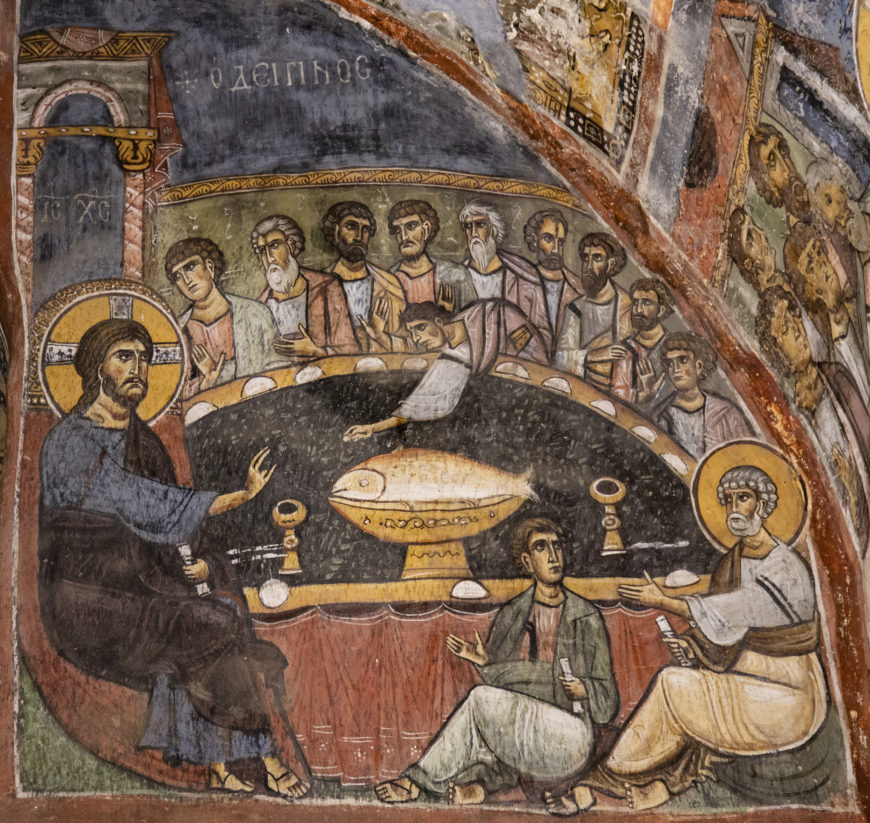
Last Supper, 1105/half dozen, Panagia Phorbiotissa, Asinou, Cyprus (photo: byzantologist, CC Past-NC-SA 2.0)
The Terminal Supper
The Last Supper, "Mystical Supper," or only "Supper" (Greek: Deipnos), represents the meal that Christ shared with his disciplines before his crucifixion, which is recorded in Matthew 26:20–29, Mark 14:17–25, Luke 22: xiv–23, and I Corinthians xi:23–26, and is commemorated on Holy Th (known every bit "Maundy Thursday" in the Latin church). Judas reaches to dip his food in a bowl, which Christ identifies as a sign of betrayal. The tabular array frequently takes the form of a tardily-antiquarian, C-shaped "sigma" tabular array as at the church of the Panagia Phorbiotissa in Asinou, Cyprus. Often, a big fish appears on the table, which may illustrate the ancient Christian use of the Greek word for "fish" (ichthys) as an acronym for "Jesus Christ, Son of God, Savior." The Last Supper is typically interpreted every bit the first commemoration of the Eucharist. (view annotated image)
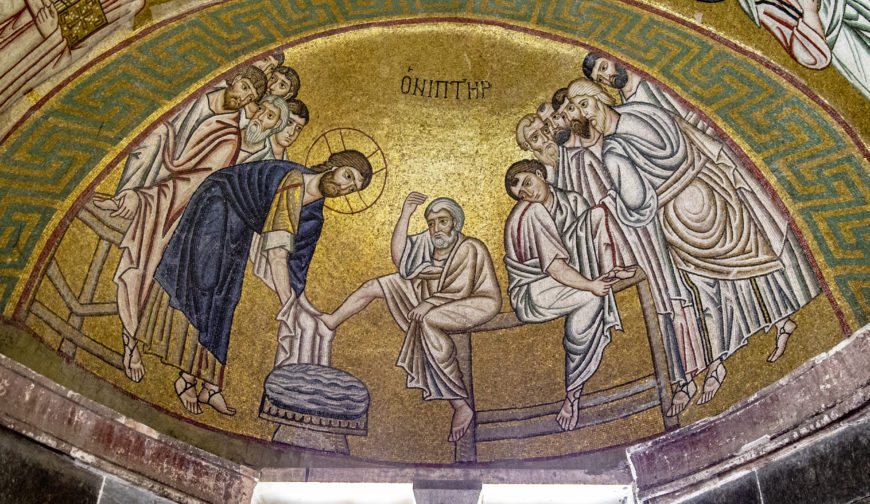
Human foot washing mosaic, 11th century, mosaic, Hosios Loukas Monastery, Boeotia (photo: byzantologist, CC BY-NC-SA 2.0)
The Washing of the Anxiety
The Washing of the Feet occurred during the Concluding Supper, according to John thirteen:ii–xv. In the Gospel business relationship, Peter resists letting Jesus launder his feet. But Christ explains: "If I, your Lord and Teacher, take done your feet, you too ought to wash one another's feet. For I have set you an example" (John 13:14–xv). The mosaic at Hosios Loukas Monastery shows Christ in the act of washing Peter's feet. (view annotated image)
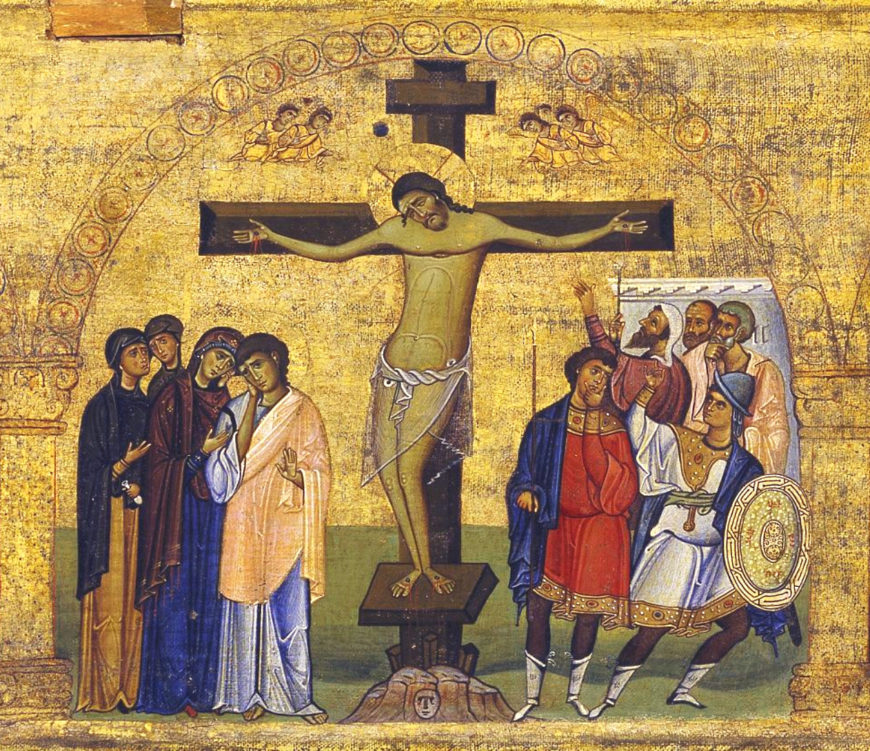
Crucifixion from templon beam with twelve feast scenes, 12th century, Cyprus or Sinai, tempera and gold over fine textile ground on panel, 44.1 x 118.three 10 iii.1 cm (The Holy Monastery of Saint Catherine, Sinai, Arab republic of egypt)
The Crucifixion
The Crucifixion depicts Christ's death on the cantankerous, described Matthew 27:32-56, Mark fifteen:21-41, Luke 23:26-49, John xix:16-37, and commemorated on Holy Friday (known as "Good Fri" in the west) during Holy Week. Simpler representations of the scene include the Virgin and John the Evangelist, illustrating John's business relationship. The dominicus and moon or angels announced in the sky above. More complex compositions, such as that found on a templon beam at Sinai, incorporate other women who followed Christ equally well as Roman soldiers, such as Saint Longinus who converted to Christianity. John recounts how one of the soldiers pierced Christ with a spear, spilling blood and water from his side (John 19:34-35). The upshot unfolds at Golgotha, the "Place of the Skull," outside of the urban center walls of Jerusalem (which sometimes appear in the background). Some depictions of this scene include a skull at the foot of the cross, which tradition identifies every bit the skull of Adam (the first man), reflecting the Christian belief that Christ is the "New Adam" equally savior of humankind. (view annotated prototype)
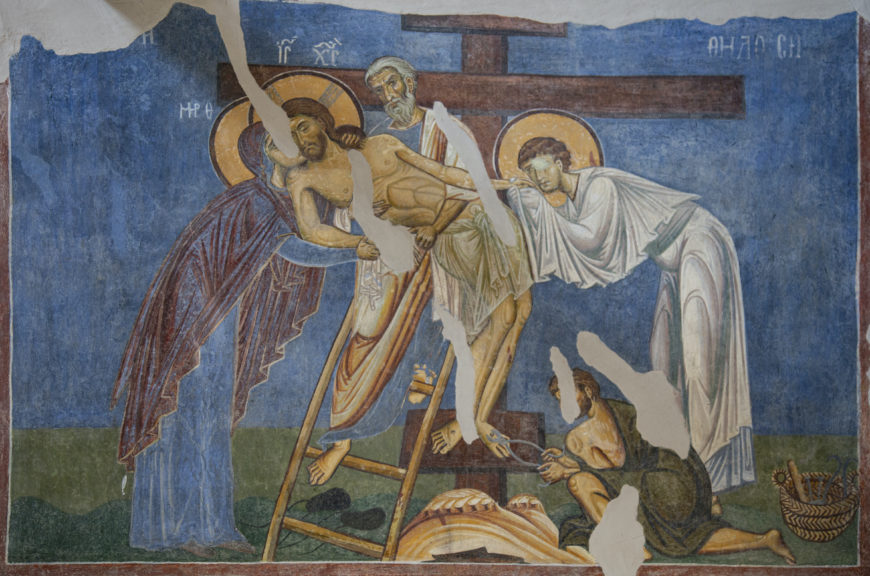
Deposition fresco, 1164, Saint Panteleimon, Gorno Nerezi, North Macedonia (photograph: byzantologist, CC BY-NC-SA two.0)
The Degradation from the Cross
The Deposition from the Cross depicts Christ's body being removed from the cross subsequently his crucifixion. Equally at the church building of Saint Panteleimon at Nerezi, the composition frequently includes the Virgin and John the Evangelist (who were present at Christ's crucifixion), too as Joseph of Arimathea and Nicodemus, ii followers of Jesus. It is based on Gospel accounts that depict Joseph of Arimathea burying Christ'southward torso in Joseph's own tomb (Matthew 27:57-61, Mark xv:42-47, Luke 23:fifty-56, John 19:38-42). (view annotated image)
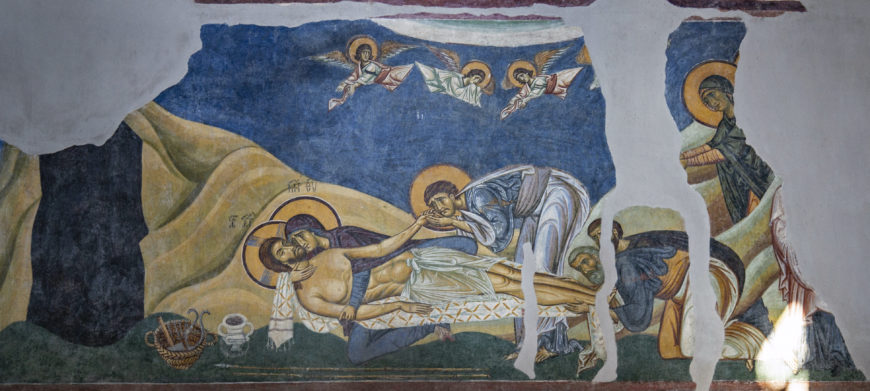
Threnos fresco, 1164, Saint Panteleimon, Gorno Nerezi, North Republic of macedonia (photo: byzantologist, CC By-NC-SA 2.0)
The Lamentation
The Lamentation, orThrenos, depicts Christ's mother and other followers mourning over Christ's dead body following the crucifixion. Equally at the church of Saint Panteleimon at Nerezi, the Lamentation often includes John the Evangelist (who was nowadays at the Crucifixion), every bit well as Joseph of Arimathea and Nicodemus, 2 followers of Jesus who helped remove his body from the cross and bury him. (view annotated paradigm)
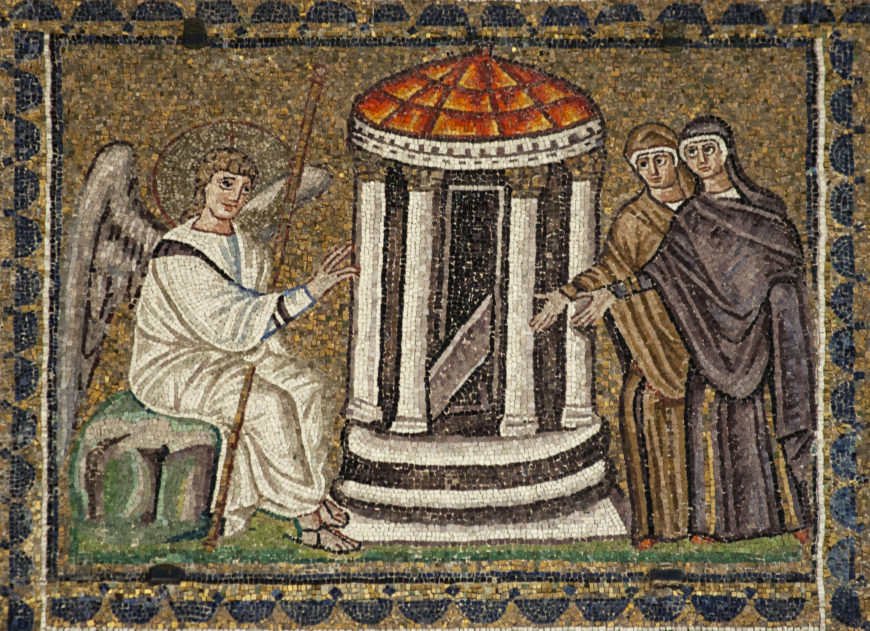
Myrrhbearing women at the empty tomb, 6th century, mosaic, Sant'Apollinare Nuovo, Ravenna (photo: byzantologist, CC BY-NC-SA 2.0)
The Resurrection
The Resurrection of Christ from the dead occurred on the 3rd day after his crucifixion according to New Testament accounts, and is celebrated each yr on Pascha (Easter). The Gospels describe women who followed Jesus as the start witnesses to Christ'south resurrection: Matthew 28:1–10; Marking sixteen:1–viii; Luke 23:55–24:12; John 20:one–18. Early Christian art depicts the
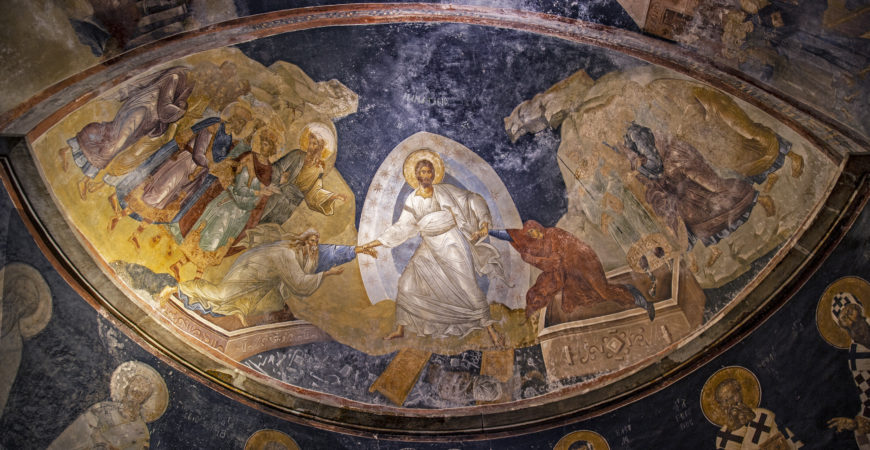
Anastasis fresco, c. 1315–1321, Chora Monastery, Constantinople (Istanbul) (photograph: byzantologist, CC Past-NC-SA 2.0)
The Anastasis
The Anastasis (Greek for "resurrection"), also known every bit the "Harrowing of Hades" or "Harrowing of Hell," became a standard resurrection composition from the eighth century onward. Based largely on non-biblical sources, the scene shows Christ descending into Hades (the underworld)—sometimes conveying his cross as an musical instrument of salvation—to raise the dead from their tombs. Locks and hinges lie broken underfoot as Christ tramples the broken gates of the underworld that in one case imprisoned the dead. In some images, Christ also tramples the personified effigy of Hades, who represents expiry. At the Chora Monastery, Christ reaches with both easily to raise Adam and Eve (the starting time humans) from their tombs. Righteous figures from the Hebrew Bible and Christian New Testament—usually David, Solomon, and John the Baptist—stand nearby. The image corresponded with the chief hymn of Pascha (Easter): "Christ is risen from the dead, trampling downwardly decease by death, and upon those in the tombs bestowing life!" (view annotated image)
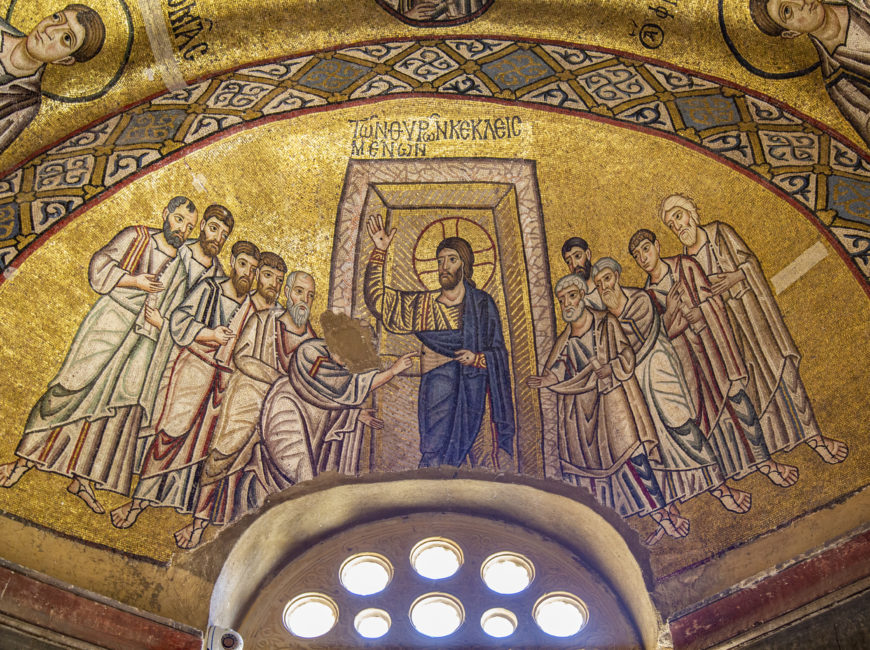
The Incredulity of Thomas, 11th century, mosaic, Hosios Loukas Monastery, Boeotia (photo: byzantologist, CC BY-NC-SA 2.0)
The Incredulity of Thomas
The Incredulity of Thomas appears in John 20:24–29, and is commemorated in the Eastern Orthodox Church the Sun afterwards Pascha (Easter). When some of the disciples claim to have encountered the risen Christ, the Campaigner Thomas expresses doubt, stating: "Unless I see the mark of the nails in his hands, and put my finger in the mark of the nails and my hand in his side, I will not believe" (John 20:25). A week later, Jesus appears and invites Thomas to touch his wounds: the moment depicted in this mosaic at Hosios Loukas Monastery. Thomas exclaims: "My Lord and my God!" (John 20:28). (view annotated image)
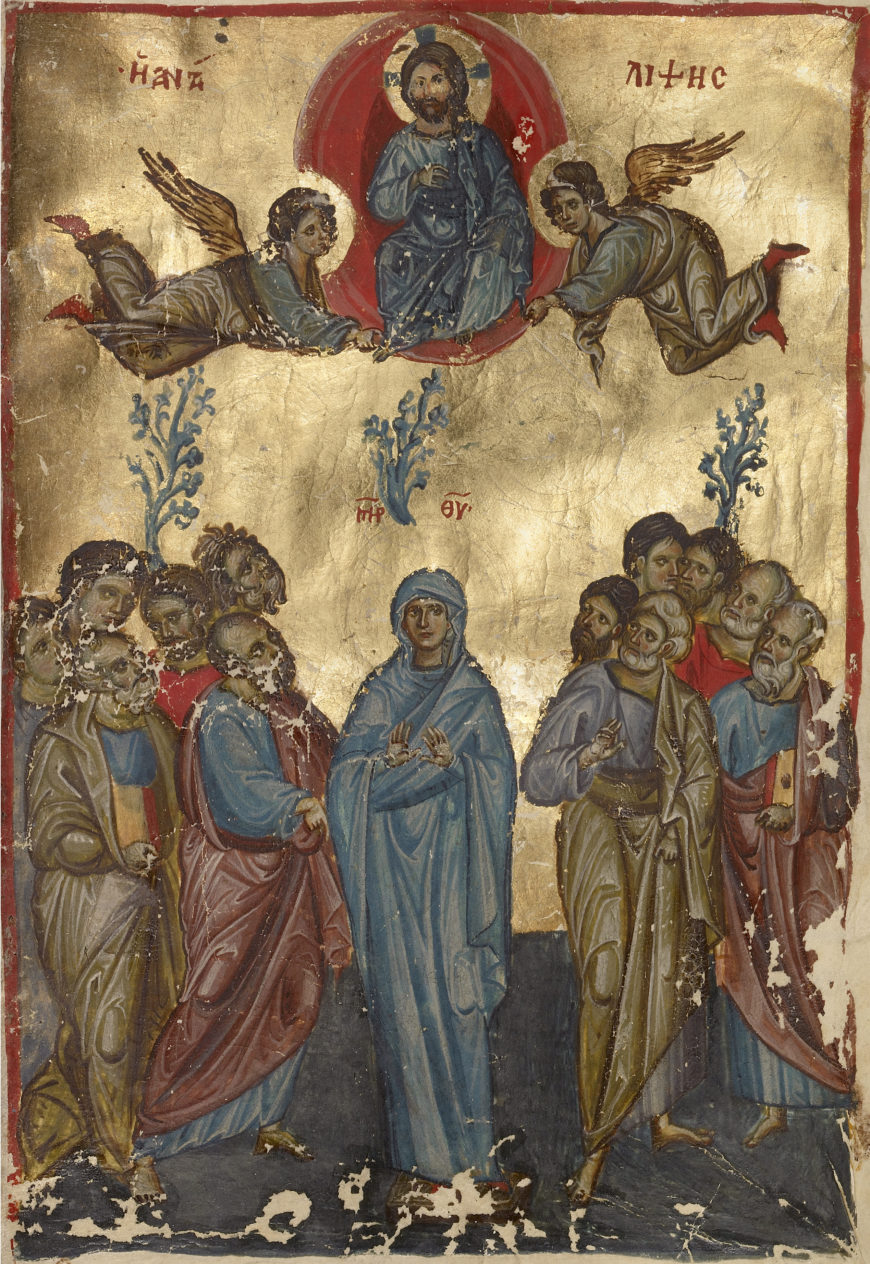
Ascension miniature, late 13th century, Nicaea or Nicomedia (modernistic Turkey), tempera and gilded leaf (The J. Paul Getty Museum)
The Ascension
The Ascension of Christ into heaven, following his resurrection from the expressionless, is described in Luke 24:50–53 and Acts ane:nine–12 and is commemorated on the Th that falls forty days after Pascha (Easter). The iconography derives from pre-Christian majestic embodiment scenes (for example, on the Arch of Titus in Rome). Christ appears within a mandorla and is borne heavenward by angels, as seen in the miniature from the Getty Museum. The Virgin and Apostles stand on earth beneath. The ascent often appeared in church vaults, corresponding with the Byzantine interpretation of the church as a microcosm with the vaults representing the heavens. (view annotated image)
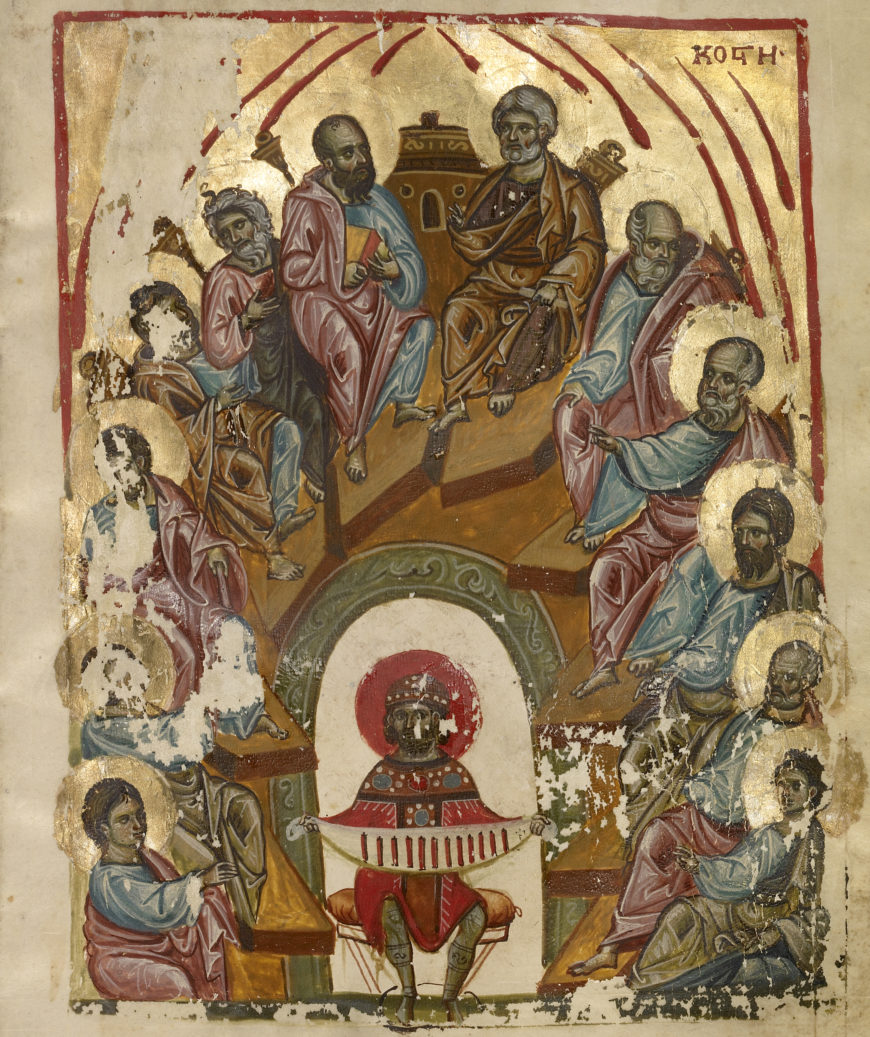
Pentecost miniature, tardily 13th century, Nicaea or Nicomedia (modern Turkey), tempera and gold leafage (The J. Paul Getty Museum)
Pentecost
Pentecost (literally "the fiftieth day") depicts the descent of the Holy Spirit on the Apostles as described in Acts 2 and is commemorated fifty days after Pascha (Easter). The Holy Spirit takes the form of tongues of fire. Sometimes the Virgin appears with the Apostles, although she is non present in the biblical account. In Acts, the Holy Spirit inspires the Apostles to preach the crucified and risen Christ in dissimilar languages so that all can understand. In creative representations of the event, figures representing different "tribes" and "tongues," or a unmarried figure personifying the entire "creation," (seen in this miniature from the Getty) receive the Apostles' words. Sometimes, the "prepared throne" ( Hetoimasia ) is included as the source from which the flames descend. (view annotated image)
The Dormition
The Dormition (Greek: Koimēsis, literally "falling comatose") represents the decease of the Virgin Mary, described in not-biblical texts and commemorated on August fifteen. The Virgin lies on her funeral bier surrounded past the Apostles. Christ stands backside the Virgin, receiving her soul, which takes the form of a swaddled infant. Later icons sometimes include boosted details such equally the Apostles miraculously borne to the scene on clouds and the gates of heaven opening to receive the Virgin. Tenth-century ivories from Constantinople like this one are amongst the primeval depictions of the Dormition. (view annotated image)
Additional resources
Alexander P. Kazhdan, ed., The Oxford Dictionary of Byzantium, 3 vols., (Oxford: Oxford University Printing, 1991).
"The life of Christ in medieval and Renaissance art"
Source: https://smarthistory.org/christ-virgin-byzantine-art/
0 Response to "Christ With Scroll Symbolizes Old Testament in Byzantine Art"
Postar um comentário